










-
-
- R&D Unit
- Industrial Vaccine Production Unit
- Vaccine and Immunization Training Unit
- Vaccine Epidemiology Unit
- Preclinical and Clinical Research and Project Coordination Unit
- Epidemiology of Pandemic-Risk Infectious Agents Unit
- Bioterrorism Unit
- Laboratory Animal Production/Testing and Preclinical Research Unit
- Tissue Culture Collection, Viral and Bacterial Culture Banking Unit
- Quality Control Laboratory Unit
- Training, Administrative, and Financial Services Unit
-
-
-
- Announcements
- Key Dates
- FAQ
- Contact
Last Added News
- Will There Be a New Pandemic?
- The article titled Portraits from Our Medical History: Dr. Tevfik Salim Sağlam has been published.
- The article titled Questions on Immunization and Vaccination and Short Answers has been published.
- Diphtheria Epidemiology in Türkiye Throughout History Has Been Published
- Portraits from Our Medical History: Dr. Elhan Özlüarda (1927-2013) Has Been Published
- ALL NEWS
World Hepatitis Day
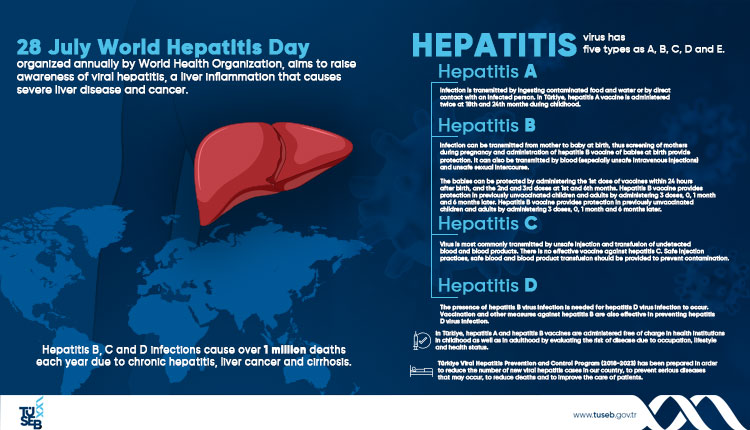
28 July World Hepatitis Day, organized annually by World Health Organization, aims to raise awareness of viral hepatitis, a liver inflammation that causes severe liver disease and cancer. The reason why July 28 was determined is that it is the birthday of Nobel Prize winner Professor Baruch Samuel Blumberg who discovered the hepatitis B virus.
This year, theme of World Hepatitis Day is determined as bringing hepatitis care closer to you.
Hepatitis virus has five types as A, B, C, D and E. The world is currently facing an outbreak of acute hepatitis infection affecting children, the cause of which is not thought to be associated with these 5 hepatitis viruses and is still unknown. As of June 2022, 920 possible cases of severe acute hepatitis from 33 countries were reported to World Health Organization. In this regard, researches including factors, exposure and risk factors are carried out. General infection prevention and control measures are recommended to prevent infection, such as maintaining hand hygiene, using safe drinking water, consuming safe food, maintaining social distance, using masks, staying at home when sick, and seeking medical attention.
In addition to most acute hepatitis infections cause mild diseases and even go undetected, in some cases they can lead severe diseases and be fatal. In 2019, it is estimated that 78.000 deaths occurred due to acute hepatitis A and E. Unlike acute viral hepatitis, Hepatitis B, C and D infections cause over 1 million deaths each year due to chronic hepatitis, liver cancer and cirrhosis. These three types are responsible for 95% of hepatitis deaths. Globally, it is prioritized to eliminate the hepatitis B, C and D infections; and the prevention of chronic viral hepatitis, increasing access to diagnose and treatment are highlighted.
Türkiye Viral Hepatitis Prevention and Control Program (2018-2023) has been prepared in order to reduce the number of new viral hepatitis cases in our country, to prevent serious diseases that may occur, to reduce deaths and to improve the care of patients. Within the scope of programme, the activities are conducted on the prevention of transmission of disease, and early detection and treatment with a multidisciplinary approach.
Hepatitis A infection is transmitted by ingesting contaminated food and water or by direct contact with an infected person. Sanitation, food safety and immunization are the most effective ways of prevention of hepatitis A. In Türkiye, hepatitis A vaccine is administered twice at 18th and 24th months during childhood.
Hepatitis B infection is most commonly transmitted from mother to baby at birth, through unsafe sex and unsafe injections. Hepatitis B infection in infancy and early childhood leads to chronic hepatitis in 95% of cases. Thus, it is particularly important to administer the 1st dose of vaccines, preferably within 24 hours after birth, and to complete the vaccine series by administering the 2nd and 3rd doses at 1st and 6th months.
In Türkiye, hepatitis A and hepatitis B vaccines are administered free of charge in health institutions in childhood as well as in adulthood by evaluating the risk of disease due to occupation, lifestyle and health status.
Hepatitis C virus is most commonly transmitted by unsafe injection and transfusion of undetected blood and blood products. There is no effective vaccine against hepatitis C. Safe injection practices, safe blood and blood product transfusion should be provided to prevent contamination.
The presence of hepatitis B virus infection is needed for hepatitis D virus infection to occur. Transmission occurs through contact with damaged skin (injection, tattoo, etc.) or infected blood or blood products. Vaccination and other measures against hepatitis B are also effective in preventing hepatitis D virus infection.
To reduce viral hepatitis and therefore prevent deaths; you should receive information from scientific sources, get vaccinated and follow other measures to prevent virus transmissions in the community, apply to health institutions for early diagnosis and treatment in a timely manner.