













-
-
- R&D Unit
- Industrial Vaccine Production Unit
- Vaccine and Immunization Training Unit
- Vaccine Epidemiology Unit
- Preclinical and Clinical Research and Project Coordination Unit
- Epidemiology of Pandemic-Risk Infectious Agents Unit
- Bioterrorism Unit
- Laboratory Animal Production/Testing and Preclinical Research Unit
- Tissue Culture Collection, Viral and Bacterial Culture Banking Unit
- Quality Control Laboratory Unit
- Training, Administrative, and Financial Services Unit
-
-
-
- Announcements
- Key Dates
- FAQ
- Contact
Last Added News
- Will There Be a New Pandemic?
- The article titled Portraits from Our Medical History: Dr. Tevfik Salim Sağlam has been published.
- The article titled Questions on Immunization and Vaccination and Short Answers has been published.
- Diphtheria Epidemiology in Türkiye Throughout History Has Been Published
- Portraits from Our Medical History: Dr. Elhan Özlüarda (1927-2013) Has Been Published
- ALL NEWS
World Immunızatıon Week 24 – 30 April 2022
European Immunization Week, which is an initiative of World Health Organization Regional Office for Europe, was first launched in 2005 worryingly that vaccination is no longer necessary as a result of vaccination bringing many infectious diseases to rare or almost unheard-of levels. The aim of initiative is designated to augment the vaccine comprehensiveness by attracting attention to necessity and right to protect every child from preventive diseases through raising awareness of healthcare professionals and policy-makers on this issue.
Immunization Week was first celebrated in 2012 with the participation of more than 180 countries in six regions of World Health Organization simultaneously. World Immunization Week held in the last week of April every year is celebrated to encourage vaccination to protect people of all ages against diseases, and the ultimate goal is to protect more people from vaccine-preventable diseases.
The 2022 theme for World Immunization Week to be held on April 24 – 30 is “Long Life for All”, which was designated by World Health Organization.
Immunization is an essential component of primary healthcare and indisputable human right. Thanks to vaccination, millions of lives are saved every year and it is accepted the most successful and one of the cost-effective health interventions.
Thanks to immunization, 2-3 million deaths are prevented every year from diseases such as diphtheria, tetanus, pertussis, influenza and measles. Smallpox was declared to be eradicated in 1980 as a result of widespread vaccination around the world. Cases due to wild polio virus worldwide have declined by over 99% since 1988, from an estimated 350.000 cases to 33 cases reported in 2018. Between 2000 and 2018, an estimated 23.2 million deaths were prevented by measles vaccination, with a 73% decrease in measles-related deaths. The number of rubella cases was also reduced by 97%; while 670,894 rubella cases were reported from 102 countries in 2000, 14,621 cases were reported from 151 countries in 2018.
With successful routine and supportive vaccination in Türkiye, serious reductions in vaccine preventable diseases have been achieved. Smallpox, which caused great epidemics and deaths, especially between 1924 and 1944, has been completely eradicated since 1977 by vaccination. Since the disease agent was eradicated, smallpox vaccinations were no longer needed and vaccination was quit in Türkiye and all over the world in 1980. There have been no cases of polio since 1998. It has been certified by the World Health Organization with the European Region Polio-Free Region Certificate, of which Turkey is a member. While the number of measles cases was 30,509 in 2001, it decreased to 84 in 2017 after effective measles vaccination. In 2009, it was documented by the World Health Organization that maternal and neonatal tetanus was minimized. No diphtheria cases were observed after 2011.
Childhood Immunization calendar implemented in our country, by the Immunization Advisory Board; epidemiology of vaccine preventable diseases in our country; scientific developments and recommendations of the World Health Organization are put into practice by Ministry of Health on issues such as the incidence of diseases, in which age groups they are more common, etc., their suitability for the program, the effectiveness and safety of vaccines. National Childhood Immunization calendar is as follows.
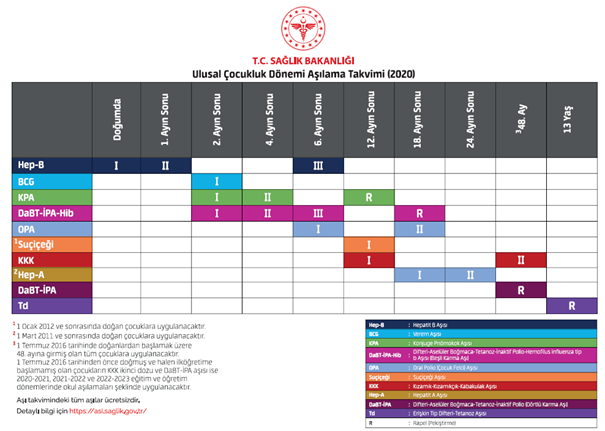
Vaccines included in the vaccination calendar are administered free of charge in family medicine units and hospitals where vaccines are administered.
Many factors, including wars, underinvestment in national immunization programs, vaccine availability, and disease outbreaks such as COVID-19, contribute to healthcare disruptions and impede the sustainable delivery of vaccination services. The World Health Organization draws attention to the alarming decline in the number of children who are vaccinated worldwide, as a result of the disruption in the provision of immunization services and service procurement due to the COVID-19 pandemic, and the risk of epidemics of vaccine-preventable diseases. Worldwide, 86% of babies received DBT3 (3rd dose of diphtheria pertussis tetanus vaccine) vaccine in 2019, while it decreased to 83% in 2020; it has been reported that 23 million children do not receive their basic vaccinations.
Immunization provides a healthy start in life and improves life expectancy; provides protection for individuals at risk, such as occupational or chronic diseases; protects individuals as well as prevents the spread of diseases and protects unvaccinated individuals. Vaccination creates a healthier, safer and more thriving world for everyone.