













-
-
- R&D Unit
- Industrial Vaccine Production Unit
- Vaccine and Immunization Training Unit
- Vaccine Epidemiology Unit
- Preclinical and Clinical Research and Project Coordination Unit
- Epidemiology of Pandemic-Risk Infectious Agents Unit
- Bioterrorism Unit
- Laboratory Animal Production/Testing and Preclinical Research Unit
- Tissue Culture Collection, Viral and Bacterial Culture Banking Unit
- Quality Control Laboratory Unit
- Training, Administrative, and Financial Services Unit
-
-
-
- Announcements
- Key Dates
- FAQ
- Contact
Turkovac Clinical Trials Booster Phase III
TSB-VAC-COV-TUR-RF3.04
"Open-Label, Multi-Centre, Phase 3 Clinical Study to Determine the Efficacy, Safety, and Immunogenicity of Booster Vaccination Against SARS-CoV-2"
The aim of this study, the primary objective is to evaluate the efficacy of the booster doses of inactivated COVID-19 vaccines administered to individuals for whom at least 90 days and at most 270 days have passed after the 2nd dose of the CoronaVac vaccine. The secondary objective is the evaluation of the safety of booster dose vaccines by determining the incidence of adverse reactions and serious adverse events; the evaluation of the immunogenicity of booster dose vaccines; the determination of the SARS-CoV-2 specific binding antibody seropositivity rate after days 0, 28 (from all volunteers), 48, 84, and 168 (from 50% of volunteers) following the booster dose; the evaluation of SARS-CoV-2 neutralizing antibodies by neutralization test after days 0, 28 (from all volunteers), 48, 84, and 168 (from 50% of volunteers) following the booster dose; the evaluation of humoral immune response by pseudo-neutralization test after days 0, 28 (from all volunteers), 48, 84, and 168 (from 50% of volunteers) following the booster dose; and to perform T-cell evaluation in 150 volunteers. The study began with the recruitment of the first volunteer on 08.10.2021, and the last volunteer recruitment took place on 28.03.2022. In the study, where 4,359 volunteers were screened, 4,340 volunteers were vaccinated. In the Inactive Booster Phase 3 study, which aims to determine the efficacy, safety, and immunogenicity of booster doses of the inactive COVID-19 vaccine administered to individuals for whom at least 90 days and at most 270 days have passed after the 2nd dose of the CoronaVac vaccine, when looking at the data collected so far belonging to the TURKOVAC and CoronaVac arms in terms of safety, no findings threatening safety have been encountered in either group. None of the systemic and local adverse events created clinical suspicion and did not negatively affect the study. In light of these data, it has been seen that the booster doses of the inactive COVID-19 vaccines used within the scope of the study are safe. In terms of the efficacy of booster dose vaccination, no significant difference was observed between the TURKOVAC and the comparator product CoronaVac arms. As a result, both vaccines administered as a booster dose led to an increase in antibody titres with an acceptable safety profile.
"Open-Label, Multi-Centre, Phase 3 Clinical Study to Determine the Efficacy, Safety, and Immunogenicity of Booster Vaccination Against SARS-CoV-2"
TSB-VAC-COV-TUR-RF3.04
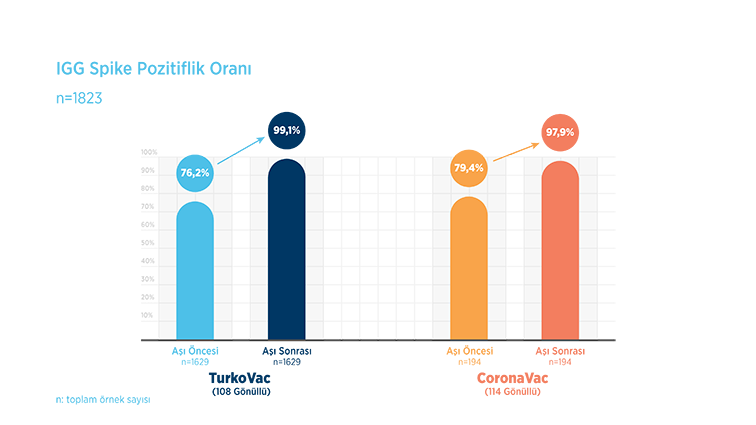
While it was observed that the effect of the previously administered primary vaccination continued in 76.2% of the volunteers who received the TURKOVAC vaccine as a booster dose before the vaccine dose, it was observed that a protective response was obtained in 99.1% of the volunteers after the booster dose administration. This can be accepted as an indicator that the booster dose is effective.
While the pre-vaccination protection continued at 79.4% for those who received the CoronaVac booster dose, this rate increased to 97.9% after the vaccination.
It was observed that the booster dose of both vaccines was effective.
"Open-Label, Multi-Centre, Phase 3 Clinical Study to Determine the Efficacy, Safety, and Immunogenicity of Booster Vaccination Against SARS-CoV-2"
TSB-VAC-COV-TUR-RF3.04
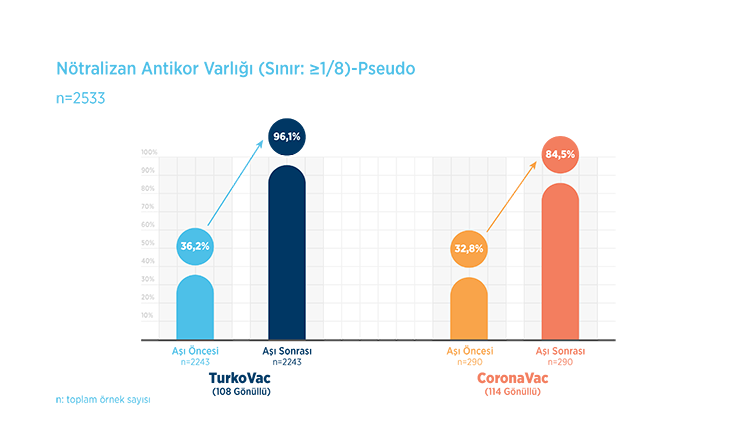
When the inhibition rate of the booster vaccine dose against the Wuhan strain, which is the original strain of SARS-CoV-2 that causes COVID-19, was examined in a laboratory environment, it was observed that while virus neutralization could be provided in 36.2% of the study group before the booster vaccine dose in the TURKOVAC vaccine arm due to the effect of the previous vaccination, this rate was 96.1% after the booster dose of the TURKOVAC vaccine. In the CoronaVac vaccine, virus neutralization, which was 32.8% before the booster vaccine, was determined to be 84.5% after the vaccine.
With these results, it has been shown that both vaccines provide effective protection against the Wuhan strain after the booster dose.
"Open-Label, Multi-Centre, Phase 3 Clinical Study to Determine the Efficacy, Safety, and Immunogenicity of Booster Vaccination Against SARS-CoV-2"
TSB-VAC-COV-TUR-RF3.04
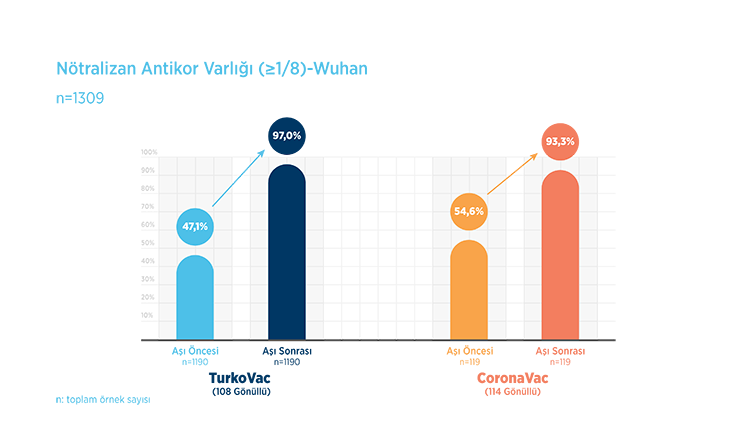
When the rate of achieving the 1/8 ratio, which is accepted as inhibiting the Wuhan strain—the original strain of SARS-CoV-2 that causes COVID-19—was examined in a laboratory environment, it was detected at a rate of 47.1% before the booster vaccine dose in the TURKOVAC vaccine arm, while this rate was observed to rise to 97.0% after the booster dose of the TURKOVAC vaccine. In the CoronaVac vaccine, the inhibition rate, which was 54.6% before the booster vaccine, was determined to be 93.3% after the vaccine.
With these results, it has been shown through another method that both vaccines provide effective protection against the Wuhan strain after the booster dose.